My Uber Eats Earnings: Two Trips Compared
One trip in my Uber Eats earnings screenshot shows $34.06 for 4 miles. Another shows $24.10 for 12.4 miles. The shorter trip paid $9.96 more and took 4 minutes 14 seconds less on the recorded trip clock. That is a much more useful comparison than just saying I had a good day.
The longer trip used about three times the displayed miles for a smaller payout. This is why I look past the dollar amount when an offer arrives. These are two historical trip records, not proof that both offers were available to choose between at the same moment.
My original October 2024 account reported earning $30 to $40 an hour while being selective. The two trips below let us examine a narrower claim: how their payouts compare with their recorded distance and duration. They do not establish a typical hourly wage.
The orders that made me pay attention
I’ve had offers come back at a higher amount after I passed on them. Some came back at $30 or more. That gets your attention pretty quickly when the first offer wasn’t worth taking.
My read at the time was that other drivers were passing too, and Uber was increasing the pay to get the order delivered. That’s how I explained it in my original post. I can describe what showed up on my screen; I can’t see Uber’s internal pricing decisions.
Would I sit there counting on every rejected order to come back? No. An offer that might return isn’t money I’ve earned. The part I can control is whether the offer in front of me is worth accepting.
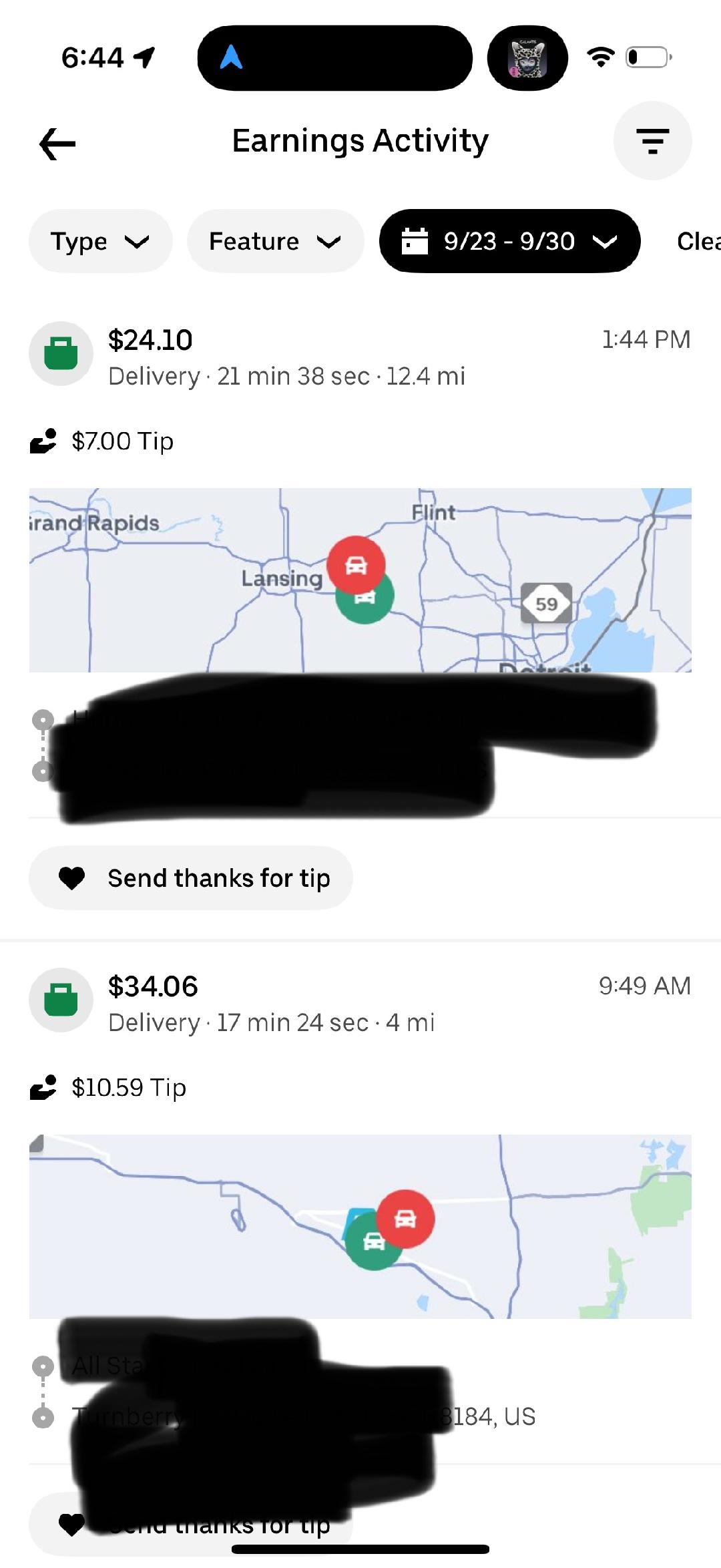
| Detail | First displayed trip | Second displayed trip |
|---|---|---|
| Displayed earnings | $24.10 | $34.06 |
| Tip line shown | $7.00 | $10.59 |
| Trip duration | 21 minutes 38 seconds | 17 minutes 24 seconds |
| Trip distance | 12.4 miles | 4 miles |
These are the fields displayed in the image, not additional payments to add together. The screenshot was included in my October 2024 article; its selected date filter is September 23–30. It does not show a complete shift, all waiting time or total work mileage.
The 4-mile trip won on all three recorded measures
| Measure | 12.4-mile trip | 4-mile trip |
|---|---|---|
| Displayed earnings | $24.10 | $34.06 |
| Recorded duration | 21:38 | 17:24 |
| Earnings per displayed mile | $1.94 | $8.52 |
The 4-mile trip produced about 41% more displayed earnings on 68% fewer displayed miles. Its earnings per displayed mile were roughly 4.4 times as high. This comparison uses the recorded trip distance, not a complete mileage log including travel afterward.
There was no trade-off between a bigger recorded payout and a longer recorded trip here: the 4-mile delivery paid more, covered less distance and finished sooner on the trip clock. That is the specific result these two records support.
Was the difference just a bigger tip?
The tip lines are $7.00 and $10.59, a difference of $3.59. The displayed earnings differ by $9.96. The increase in the tip line is therefore smaller than the increase in displayed earnings.
If the listed tips are included in those displayed totals, subtracting them leaves $17.10 and $23.47, a $6.37 difference. Those remainders should not be called base fares without the detailed receipts: they could include other pay components. Either way, adding the tip lines again would risk counting money twice.
What this says about passing on orders
These trips show why I prefer a strong payout attached to a short trip. They do not show what I declined beforehand, how long I waited for either offer, or what I could have earned by accepting something else. My story about offers returning at higher amounts remains a personal observation, not a pricing rule established by this screenshot.
To test whether being more selective improves a whole shift, the missing evidence is the time between jobs and the full miles driven. A delivery receipt cannot tell us the cost of waiting for it.
Method: this comparison uses the figures already transcribed in this article from its historical screenshot. Pay per mile is displayed earnings divided by displayed distance, rounded to cents. Percentage comparisons use the 12.4-mile trip as the baseline. No current market rates or new delivery results were added. The original image could not be independently re-downloaded during this analysis.
Before tips and after tips are different numbers
That screenshot is why I pay attention to the breakdown. If someone says they made a certain amount on an order, I want to know how much came from the fare and how much came from the tip.
Uber’s current U.S. explanation says the upfront amount includes base fare and any upfront tip. Additional tips and applicable adjustments can show up afterward. So the amount on the offer screen isn’t automatically what Uber is paying before tips.
The completed receipt is where to check what actually made up the earnings. That tells you more than just looking at the biggest number.
When do Uber Eats drivers get paid?
Uber’s U.S. delivery page describes weekly automatic bank transfers and Instant Pay cash-outs up to six times a day for a fee. Check the options, available balance and fee shown in your own account before requesting a cash-out. Payout guidance checked September 10, 2026.
Keep three numbers separate when reviewing a day:
- The offer: what the app shows before you accept.
- Completed earnings: the amounts recorded after deliveries, including the tip and adjustment breakdown.
- The bank deposit: the transfer you receive after cashing out or the scheduled payout.
A cash-out is a transfer of earnings, not another delivery payment. Do not add the deposit to the trip earnings when totaling your day. Record any cash-out fee separately so you can see what reaching your money costs.
Don’t turn one good hour into an imaginary workweek
I’m happy with the good orders I’ve had. But taking a $40 hour and multiplying it across every hour you plan to work is getting ahead of yourself.
Count the waiting, too. Count the miles. If you spend six hours trying to earn money, those six hours matter even if you only have orders for four of them. I’ve put the arithmetic in the time-and-mileage guide if you want to compare your own shifts.
If you are considering DoorDash alongside Uber Eats, read the multi-app guide to comparing offers and tracking one shared shift. Two apps running during the same hour do not create two hours of work. Compare available offers, then give the delivery you accept enough time to finish properly.
The flexibility is still what I like about this work. I can choose a lunch or dinner window that fits my other commitments. I don’t have to like every offer that arrives during it.
My approach is pretty simple: know the restaurants and areas you work, look for worthwhile short trips, and be willing to pass. The app offering me a delivery doesn’t make it a good delivery.
If you want to see how I approach other apps, here’s my reported $426 Spark day with original screenshots. That account explains the difference between the displayed trip estimates and my reported payout. It is not a number to assume you will make tomorrow.
Based on my original October 2024 account. Edited for clarity in September 2026; the linked U.S. pay explanation was checked September 9, 2026.
Featured photo: Rowan Freeman / Unsplash. Illustrative delivery photo; the earnings screenshot in this article is from my own post.
Follow the next driver report. Subscribe to Gigs Driver updates for new earnings stories and practical delivery guides.